Incheon Travel Guide 2026 – Chinatown, Open Port District, and Wolmido
Hi there, this is Ssenea. 😎
Most international visitors to Korea encounter Incheon exactly once: arriving at or departing from its airport. That's a reasonable choice, given that Seoul is 70 minutes away by direct rail and contains most of what people come to Korea to see. But treating Incheon as a transit point misses something genuinely worth a day of attention.
Almost nobody plans actual days around Incheon, and that's what makes it interesting — it's one of the most under-explored major cities in Korea for international visitors. The Jung-gu district around Chinatown and the Open Port area contains Korea's only genuine Chinatown, a walkable stretch of colonial-era architecture from three different colonial powers, and a harbor district that tells a more layered version of modern Korean history than most visitors encounter. This guide covers how to get there and what to actually do with a day in Incheon in 2026.
Getting to Incheon from Seoul
Metro Line 1 — The Standard Option
The journey from central Seoul takes around 70 minutes on Metro Line 1 to Incheon Station. This is the most practical and cheapest option.
| Departure | Arrival | Duration | Price |
| Seoul Station | Incheon Station | ~60 min | ₩1,750 |
| Sindorim Station | Incheon Station | ~45 min | ₩1,550 |
Note: Incheon Station (인천역) on Metro Line 1 is different from Incheon International Airport. Do not take the AREX airport express — it goes to the airport, not the city. Take the regular blue Line 1 train to the terminus at Incheon Station.
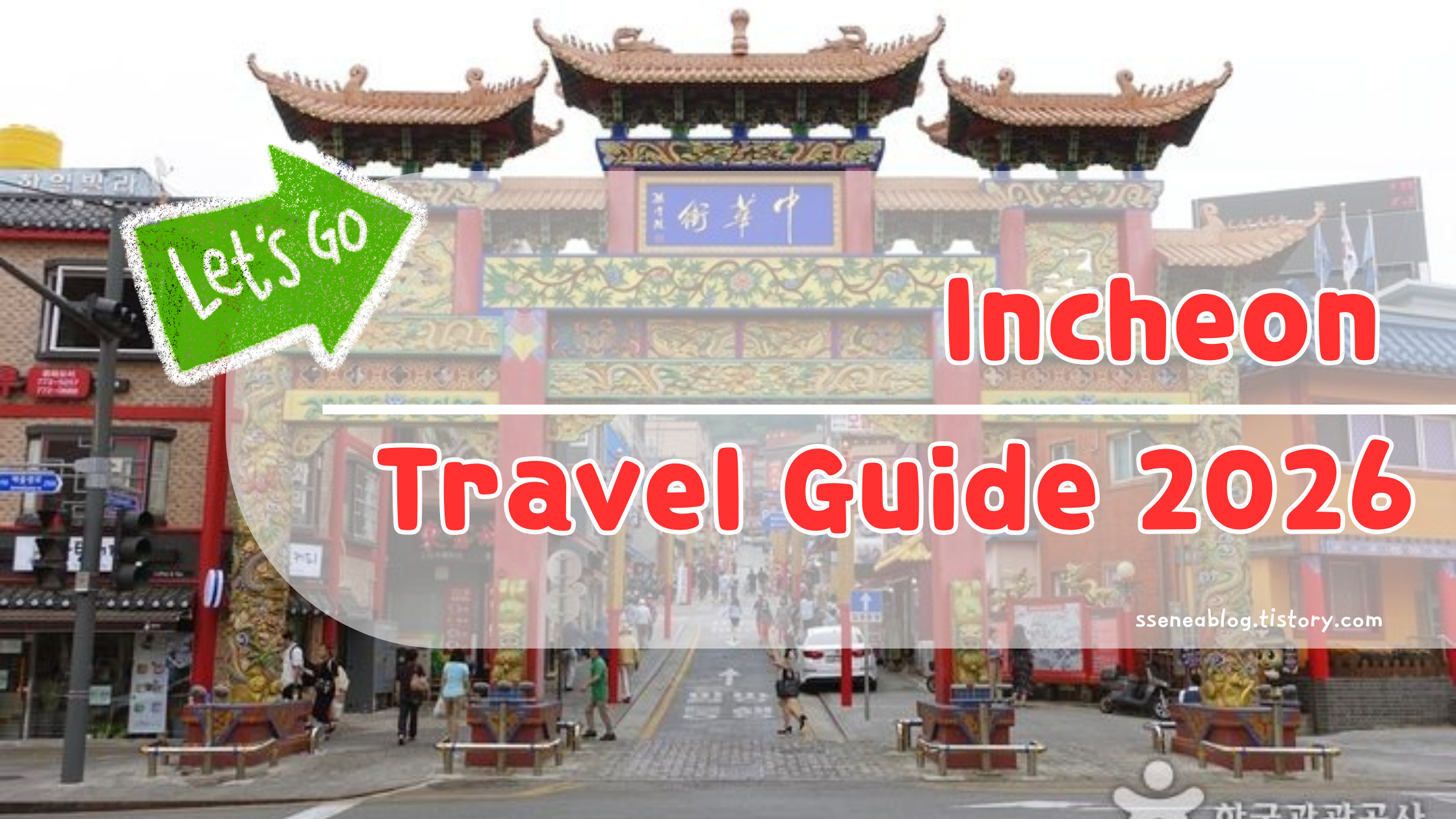
Incheon Station drops you right at the entrance to Chinatown, marked by a large paifang (Chinese gateway arch) that you can't miss. The walk from Incheon Station through Chinatown and into the Open Port district takes about 20–30 minutes at a relaxed pace — no taxis needed for the main circuit.
What to See — The Main Circuit
1. Incheon Chinatown (인천 차이나타운) — Korea's Only Chinatown
Korea's Chinatown is unlike any other Chinatown. It's compact, a bit worn around the edges, and deeply focused on one thing: jjajangmyeon. Black bean noodles were invented here (or at least perfected here, depending on who you ask), and the main street is lined with restaurants that have been making them for decades.
It is the only official Chinese quarter on the Korean peninsula, founded in 1884. When Incheon Port opened to foreign trade in 1883, Chinese merchants and laborers followed shortly after, establishing a community that has persisted for over 140 years. The architecture is distinctively Chinese — red facades, painted wooden gates, Chinese lanterns — though the neighborhood's scale is modest compared to Chinatowns in larger international cities.
What to do here:
- Eat jjajangmyeon at one of the century-old restaurants. Jjajang is thicker and more savory than the sweet Chinese version, with chunky pork and vegetables in a fermented black bean sauce. Expect to pay ₩8,000–12,000 per bowl.
- Walk the Romance of the Three Kingdoms mural street (삼국지 벽화거리) — a long alley with painted murals depicting scenes from the Chinese classic. It's free and surprisingly extensive.
- Try gonggalbang (공갈빵) — hollow, crispy Chinese-style bread sold by street vendors. The interior is air, which sounds disappointing but the caramelized shell is the point.
2. Jjajangmyeon Museum (짜장면 박물관) — Where the Dish Was Born
The former Gonghwachun restaurant building — originally opened in 1905 — is now a museum dedicated to the history of jjajangmyeon in Korea. The exhibits trace how Chinese immigrants adapted their cuisine to Korean tastes over generations, producing a dish that has become one of Korea's most beloved comfort foods.
The Incheon Open Port Museum charges ₩500 for adults as of 2026 and covers the history of the port opening period.
The jjajangmyeon museum sits directly in Chinatown and is worth the ₩1,000 admission for the building alone — the restored Gonghwachun interior gives a clear sense of what a prosperous Chinese restaurant in colonial-era Korea looked like. Allow 30–45 minutes.
Admission: ₩1,000 / Hours: 09:00–18:00 / Closed: Mondays
3. Sinpo-Japanese Boundary Stairs and the Open Port District (개항장 거리)
One of the most visually specific moments in the Incheon circuit is a staircase — the boundary steps between the Chinese concession and the Japanese concession during the colonial period. Walk down the stairs from Chinatown and the architecture changes immediately: from red Chinese facades to wooden Japanese-style buildings and Western colonial structures.
The surrounding Open Port district has restored colonial-era buildings from Japanese, Chinese, and Western traders. The surrounding streets include the former Japanese Consulate building and a stretch of preserved architecture that gives a tangible sense of a city at the intersection of colonial powers.
Key stops in the Open Port district:
- Daebul Hotel Exhibition Hall (대불호텔 전시관): The first Western-style hotel in Korea, opened 1888, now restored as an exhibition space. Free entry.
- Incheon Open Port Museum (인천 개항장 근대 건축 전시관): Housed in the former 18th Japanese Bank building — one of the finest examples of early 20th century colonial banking architecture still standing in Korea. ₩500 admission.
- Incheon Art Platform (인천아트플랫폼): Former port warehouses converted into artist studios and exhibition spaces. Worth walking through even if no exhibition is running.
- Café Pattal (팟알): A well-regarded café in the Open Port district known for handmade castella (Japanese-style sponge cake) and patbingsu (shaved ice with red beans). The building itself is part of the appeal.
4. Jayu Park (자유공원) — Korea's First Western-Style Public Park
Jayu Park sits on a hill directly above Chinatown and claims to be the first Western-style public park in Korea, established in 1888. The park is free to enter and open throughout the day.
The main draw for many visitors is the statue of General Douglas MacArthur, which marks the site associated with the 1950 Incheon Landing — the surprise amphibious assault that turned the course of the Korean War.
From the park's viewpoint, the harbor spread below — the same harbor through which the UN forces arrived in September 1950 — gives a sense of why the location mattered strategically. It's a 15–20 minute uphill walk from Chinatown, entirely manageable.
Admission: Free / The walk up from Chinatown takes about 15 minutes

5. Songwol-dong Fairy Tale Village (송월동 동화마을)
A short walk from Chinatown in the opposite direction from the Open Port district is Songwol-dong, a hillside neighborhood repainted in 2013 with murals depicting European fairy tales — Little Red Riding Hood, Pinocchio, The Little Mermaid, and others spread across roughly 70 painted scenes.
The village is genuinely charming if slightly kitsch, and provides a contrast to the colonial-era weight of the Open Port district. It's popular with Korean day-trippers for photos, and the narrow alleyways are reasonably picturesque even when crowded. Plan 30–45 minutes.
6. Wolmido Island (월미도) — Seaside and the Wolmi Sea Train
Wolmido is a 10–15 minute taxi ride from Chinatown and rounds out a full day in Incheon's Jung-gu district. The island has a seafood restaurant strip along the waterfront, an amusement park area, and the Wolmi Sea Train — a coastal monorail that runs along the water's edge with harbor views.
Wolmi Sea Train: ₩8,000 per adult (round trip) / Runs daily except Monday and Tuesday — check the schedule before planning around it.
The seafood market and restaurant street on Wolmido is the best place to eat in the area if you want something other than jjajangmyeon — raw fish, seafood noodles, and shellfish dishes from the West Sea. Prices are reasonable by Seoul standards.
What to Eat in Incheon
| Dish | What It Is | Where to Find It |
| Jjajangmyeon (짜장면) | Black bean noodle — the dish Chinatown invented | Any Chinatown restaurant |
| Tangsuyuk (탕수육) | Sweet-and-sour pork, order alongside jjajangmyeon | Chinatown restaurants |
| Gonggalbang (공갈빵) | Hollow crispy Chinese bread | Chinatown street vendors |
| Sinpo Dakgangjeong (신포닭강정) | Incheon's famous fried chicken — takeout only | Sinpo Market (신포시장) |
| Handmade castella | Japanese-style sponge cake from local bakeries | Café Pattal, Open Port cafés |
| Seafood | Fresh West Sea catches | Wolmido restaurant strip |
The jjajangmyeon question: Most people should eat at one of the older Chinatown restaurants rather than a newer or more photogenic option. The restaurants that have been there for decades produce a more authentic result. Gonghwachun (the original restaurant, now the museum) no longer serves food, but the street around it has plenty of options.
Practical Information
Day trip vs overnight: Incheon is best as a day trip. One full day covers Chinatown, the Open Port district, Jayu Park, Songwol-dong, and Wolmido with time for a proper lunch and an afternoon coffee in the Open Port cafés. There's no particular reason to stay overnight unless you're catching an early flight from the airport.
Line 1 vs AREX: The most common visitor mistake in Incheon. AREX goes to the airport; Metro Line 1 goes to Incheon Station (the city). They are entirely different lines. Line 1 is what you want.
English: The major tourist sites have English signage, and museum staff at the Jjajangmyeon Museum and Open Port Museum typically speak enough English to help. Restaurant menus in Chinatown are often bilingual. Away from the tourist district, English becomes limited quickly.
Closing days: The Jjajangmyeon Museum is closed Mondays. The Wolmi Sea Train does not run on Mondays or Tuesdays. Plan around these if your day falls on a Monday.
Safety: Low violent crime; watch for pickpockets in busy transit hubs and crowded tourist spots. Chinatown and the Open Port district are safe for solo travelers including solo women.
Suggested Itinerary — One Full Day
| Time | Stop |
| 10:00 AM | Arrive Incheon Station via Metro Line 1 |
| 10:00–11:30 AM | Chinatown walk + jjajangmyeon breakfast/lunch |
| 11:30 AM–12:00 PM | Jjajangmyeon Museum |
| 12:00–1:30 PM | Open Port District: Daebul Hotel, 18th Bank Museum, Art Platform |
| 1:30–2:30 PM | Café Pattal or Open Port café — castella and coffee |
| 2:30–3:30 PM | Songwol-dong Fairy Tale Village |
| 3:30–4:30 PM | Jayu Park (MacArthur statue + harbor view) |
| 5:00–7:00 PM | Wolmido — Sea Train + seafood dinner |
| 7:30 PM | Metro Line 1 back to Seoul |
Incheon Is Worth the 70 Minutes
The version of Incheon most visitors get — airport, taxi, Seoul — leaves out the part that's actually interesting. The Jung-gu district around Chinatown and the Open Port is compact, walkable, historically layered in ways that few Korean destinations are, and reachable on a transit card that most Seoul visitors already have.
A day in Incheon works as a deliberate choice rather than an afterthought. The jjajangmyeon alone is worth the subway fare.
Looking for more destinations within easy reach of Seoul? Check out our guides to Jeonju and Gyeongju for two more cities worth a day trip.
🇰🇷 Read this in Korean: 인천 개항장 여행 코스 2026
인천 개항장 여행 코스 2026 – 차이나타운·근대건축·월미도 당일치기 완벽 가이드
인천 개항장 여행 코스 2026 – 차이나타운·근대건축·월미도 당일치기 완벽 가이드안녕하세요. Ssenea 입니다. 🥰서울에서 멀리 가지 않고도 이국적인 분위기를 느끼고 싶은 곳이 있다면 인천 개
sseneablog.tistory.com
'어디 가볼까' 카테고리의 다른 글
| 서울 야외 데이트 코스 추천 2026 – 산책하기 좋은 감성 명소 4곳 (0) | 2026.08.19 |
|---|---|
| 서울 피크닉 명소 추천 2026 – 한강 말고 가볼 만한 공원 4곳 총정리 (1) | 2026.08.13 |
| 인천 개항장 여행 코스 2026 – 차이나타운·근대건축·월미도 당일치기 완벽 가이드 (0) | 2026.08.12 |
| 통영 여행 코스 2026 – 케이블카·동피랑·루지·해산물 당일치기 완벽 가이드 (0) | 2026.08.12 |
| Jeonju Travel Guide 2026 – Korea's Food Capital and Hanok Village (0) | 2026.08.12 |