Korean BBQ Guide for Beginners 2026 – How to Order, Grill, and Eat Like a Local
Hi there, this is Ssenea. 😎
Korean BBQ is the one thing nearly every visitor to Seoul says they want to do before they arrive and the one they say they want to repeat immediately after doing it. The format is simple: raw meat arrives at the table, a grill in the centre is lit, and you cook the meat yourself. But simple does not mean obvious — the first time at a Korean BBQ table without guidance tends to produce overcooked meat, missed components, and a vague sense that you did it wrong.
This guide covers everything a first-timer needs: how to choose a restaurant, what to order, how the meat is actually grilled, how to eat it, what the etiquette is, and which neighbourhoods have the best options in 2026. The goal is a Korean BBQ experience that feels like the real thing rather than a tourist version of it.
How Korean BBQ Restaurants Work
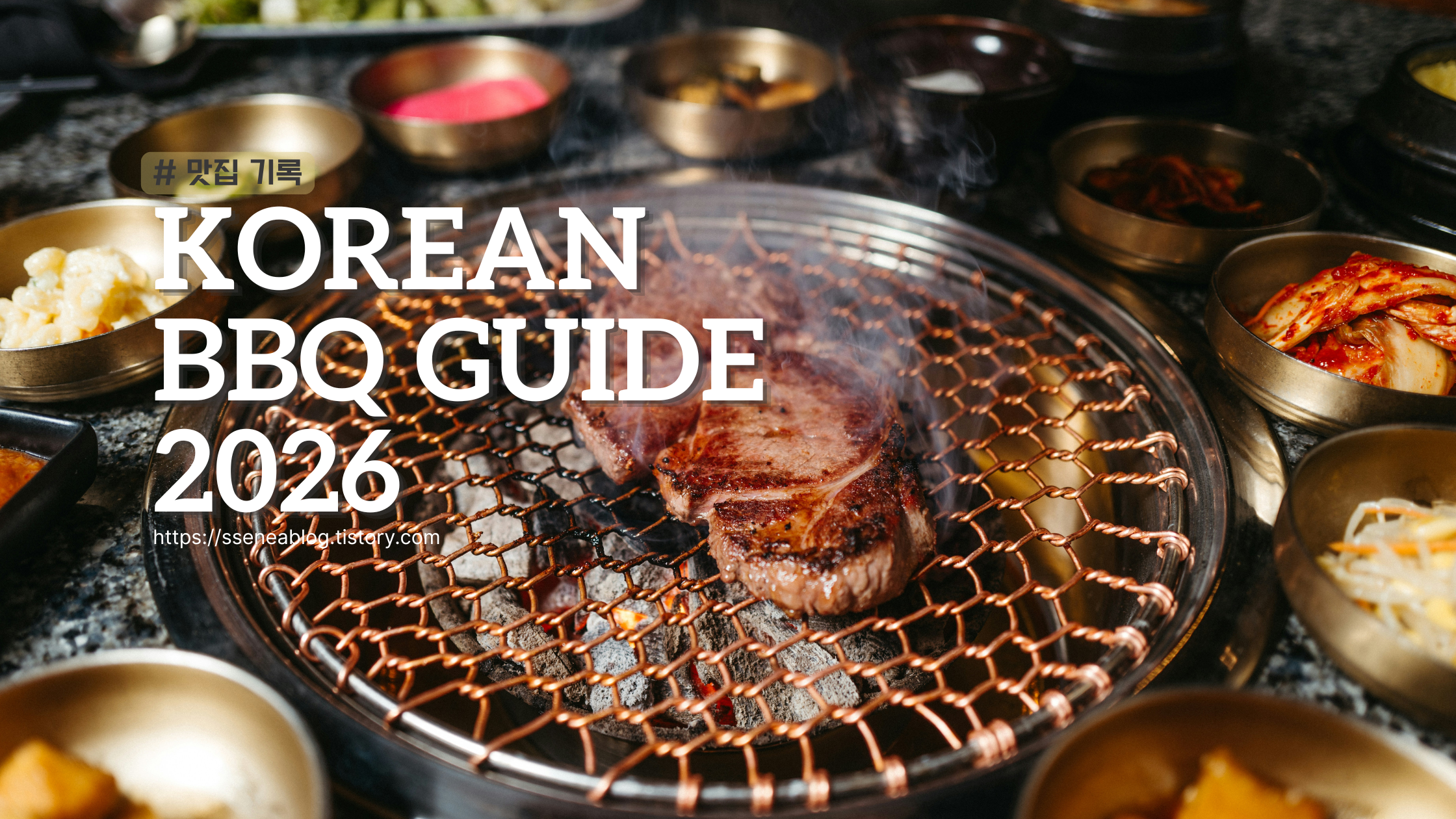
Korean BBQ restaurants are built around a gas or charcoal grill recessed into the centre of the table. You sit, meat arrives raw, and you cook it. This is not a novelty — it is the format, and it applies equally to a neighbourhood pork belly joint in Mapo and a premium hanwoo beef restaurant in Gangnam.
A few things to understand before you sit down:
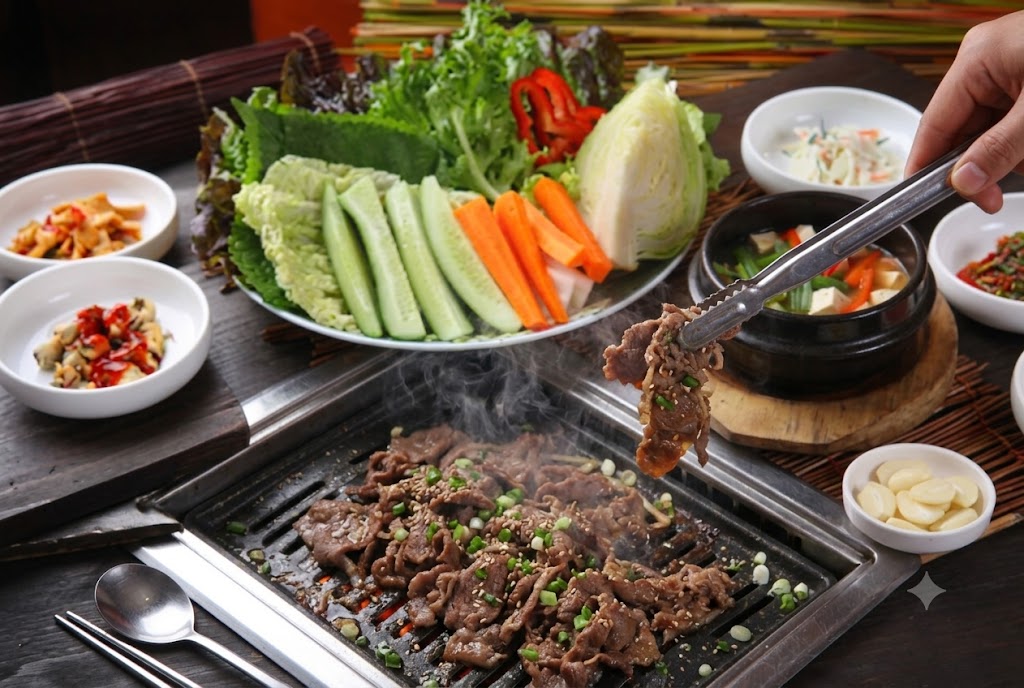
Banchan arrives first and is free. When you're seated, small side dishes appear automatically: kimchi, seasoned spinach, pickled radish, bean sprout salad, and sometimes sliced garlic, green onion, and perilla leaves for wrapping. These are included in the price of the meal. Refills are free — flag down staff or press the call button.
The call button is normal. Most Korean restaurants have a button at the table to call staff. Use it freely. Waving or making eye contact works too, but the button is the standard.
You pay by the portion, not by time. One portion (1인분) is typically enough for one person if you order two or three types. Portions come in either individual serving sizes or table-sharing quantities depending on the restaurant.
Scissors are essential. Staff will cut the meat at the table using scissors — or hand you the scissors to do it yourself. This is how Korean BBQ works. The scissors are not odd; they are the correct tool.
The Meat — What to Order
Samgyeopsal (삼겹살) — Pork Belly
The everyday BBQ choice. Thick-cut pork belly, unseasoned, cooked on a flat iron griddle until the fat renders and the edges char. The texture contrast between crispy fat and tender meat is the point.
Samgyeopsal is what most Korean families eat on a regular Friday night. It is not a special-occasion dish. It costs ₩15,000–20,000 per portion (approximately 150–200g) and is the starting point for anyone new to Korean BBQ.
Galbi (갈비) — Marinated Short Ribs
Beef or pork short ribs cut crosswise to expose bone segments, marinated in a sweet soy-based sauce with garlic, ginger, and Asian pear. The marinade caramelizes on the grill and produces a sticky, smoky result that is one of the more distinctive Korean BBQ flavors.
Beef galbi (소갈비) is the more expensive version. Pork galbi (돼지갈비) is more affordable and widely available. If you're ordering galbi for the first time, pork galbi is the lower-stakes introduction.
Bulgogi (불고기) — Marinated Beef
Thinly sliced beef — usually ribeye or sirloin — marinated in soy, sugar, sesame oil, garlic, and Asian pear. Cooked quickly on a grill pan with high heat. The thin slices cook in approximately 90 seconds per side.
Bulgogi is sweeter and more delicate than galbi. It is excellent but less dramatic than pork belly at the grill. Many restaurants serve bulgogi in a shallow pan rather than directly on the grill.
Chadolbaegi (차돌박이) — Thinly Sliced Brisket
Paper-thin slices of beef brisket with visible fat marbling. Cooks in approximately 20–30 seconds per side. Usually dipped in sesame oil with salt before eating. This is a good choice if you want something that cooks fast and showcases the quality of the beef directly, without marinade.
Hanwoo (한우) — Premium Korean Beef
Korean domestic cattle (한우) produce beef with fat marbling comparable to Japanese wagyu. It is considerably more expensive — expect to pay ₩50,000–100,000 per portion for premium cuts — but the quality difference is significant. Hanwoo-specialist restaurants in Gangnam and Cheongdam are where to go for this experience.
How to Grill — Step by Step
This is where most first-timers go wrong. Korean BBQ is not difficult, but there is a correct process.
Step 1: Let the grill heat fully. Wait until the grill surface is hot before adding meat. Putting meat on a cold grill causes it to steam rather than sear.
Step 2: Add the meat in a single layer. Do not pile meat. One layer, with some space between pieces, produces better results.
Step 3: Do not move the meat immediately. Let it cook without touching for 60–90 seconds until the bottom develops colour. Moving it too early causes sticking.
Step 4: Flip once. Korean BBQ is not a constantly-turned affair. Flip when the underside is done. One flip is usually enough.
Step 5: Cut the meat when ready. Use the scissors provided to cut into bite-sized pieces. Cut on the grill, not on the plate.
Step 6: Replace the grill when it gets too dark. Staff will replace the grill grate when it accumulates too much burnt residue. Let them do this — do not try to clean it yourself.
How to Eat — Wrapping and Dipping
The eating method is as important as the cooking. Here is the complete format:
The ssam (쌈) wrap: Take a perilla leaf or lettuce leaf in your non-dominant hand. Add a small amount of rice (optional). Place one piece of meat on top. Add a small amount of ssamjang (the dark, fermented paste). Add sliced garlic (raw or briefly grilled), green onion, and kimchi if you like. Fold the leaf around everything and eat in one bite.
The one-bite rule is not optional — biting into a half-eaten ssam wrap is considered bad form.
Ssamjang (쌈장): The thick, dark brown paste made from doenjang (fermented soybean) and gochujang (chili paste). This is the condiment the entire eating format depends on. It is salty, slightly spicy, and deeply savory. Use a small amount — it is powerful.
Sesame oil and salt: Usually served as a dipping option for non-marinated cuts like chadolbaegi. Briefly dip the cooked meat in sesame oil, then touch it lightly to the salt dish. This is the complete seasoning.
Kkakdugi (깍두기): Cubed radish kimchi, commonly served with BBQ. Eat it alongside the meat between bites of rice.
What to Drink
Soju: The standard BBQ pairing. A 360ml bottle costs ₩4,000–6,000 at restaurants. Soju is drunk in shots, not sipped. The etiquette: pour for others, not yourself. Receive with two hands or with one hand supporting the other arm at the elbow. The first shot is usually drunk together.
Makgeolli (막걸리): Unfiltered rice wine, creamy and slightly effervescent. Lower alcohol than soju, naturally sweet, and particularly good with pork belly. Served in a bowl rather than a shot glass.
Beer: Widely available. The "somaek" combination — soju mixed with beer in a specific ratio — is the most common social drink at BBQ tables. The ratio varies by preference; ask someone at the next table if you want the local standard.
Non-alcoholic: Sikhye (식혜), a sweet fermented rice drink, is available at some restaurants. Soft drinks are always available. Water is free and self-serve.
Etiquette — What to Know
Pour for others, not yourself. This applies to soju, beer, and tea. Keep an eye on others' glasses and refill when they're empty. Others will do the same for you.
The eldest or most senior person eats first. In a formal group setting, wait for the most senior person to begin. In casual tourist settings, this is rarely enforced, but it is the custom.
Do not stick chopsticks upright in rice. This resembles incense at a funeral. Lay them flat on the rest.
The grilling is often done by one person. Informally, someone at the table becomes the designated griller. There is no rule — it usually becomes obvious who has the most interest. If you are the most interested, grill. If not, offer banchan and drinks instead.
Tipping is not practiced in Korea. Do not leave cash on the table. The price on the bill is the total price.
Where to Go — Neighborhood Guide
| Neighborhood | Best For | Price Range Per Person |
| Mapo / Sangam (마포·상암) | Everyday samgyeopsal at local prices | ₩15,000–25,000 |
| Hongdae (홍대) | Late-night BBQ, mixed crowd | ₩15,000–25,000 |
| Insadong / Jongno | Traditional galbi in older restaurants | ₩20,000–35,000 |
| Gangnam / Cheongdam | Premium hanwoo beef BBQ | ₩50,000–150,000 |
| Itaewon | English-friendly, international crowd | ₩20,000–40,000 |
Mapo is the right neighborhood for a first BBQ. The Mapo and Sangam areas northwest of central Seoul have the highest concentration of high-quality, locally-priced samgyeopsal restaurants in the city. These are neighbourhood restaurants serving local workers and families at genuine prices — not tourist-facing establishments. A full dinner with soju and banchan costs around ₩20,000–30,000 per person. Take Line 5 to Mapo Station (마포역).
Practical Notes
Reservations: Most neighbourhood BBQ restaurants do not take reservations. Arrive before 7 PM on weekdays to avoid a wait. Weekend evenings are busy everywhere — expect 15–30 minutes.
Ventilation: Good BBQ restaurants have strong ventilation — a hood directly over each grill table. If the ventilation is weak, your clothes will absorb smoke significantly. This is a known variable of the experience, not a failure of the restaurant.
Vegetarian BBQ: Available at specialist restaurants but rare in standard BBQ settings. Look specifically for vegetarian Korean BBQ restaurants in Itaewon and Hongdae.
Budget planning: A full BBQ dinner — 2–3 meat portions, banchan, rice, and soju — typically costs ₩25,000–40,000 per person at neighbourhood restaurants, ₩30,000–50,000 at mid-range, and considerably more for hanwoo specialists.
Korean BBQ Quick Reference
| Meat | Korean | Flavor Profile | Best For |
| Pork belly | 삼겹살 (samgyeopsal) | Rich, fatty, unseasoned | First-timers, everyday BBQ |
| Pork short ribs | 돼지갈비 (dwaeji galbi) | Sweet soy, caramelized | Flavor-forward, approachable |
| Beef short ribs | 소갈비 (so galbi) | Premium sweet soy | Special occasions |
| Marinated beef | 불고기 (bulgogi) | Sweet, tender, quick-cooking | Lighter option |
| Thin brisket | 차돌박이 (chadolbaegi) | Clean, buttery, with sesame | Beef lovers, quick cook |
| Korean beef | 한우 (hanwoo) | Highly marbled, premium | Serious beef experience |
One Table, Two Hours, One of the Best Meals You'll Have
Korean BBQ is not complicated when you know what you're doing — and once you've done it properly, the appeal is immediately obvious. The combination of good meat, live fire, shared food, and the ritual of wrapping and eating together makes it genuinely one of the better dining experiences anywhere.
The best advice: go to Mapo, order samgyeopsal and galbi, let the staff grill for you the first time while you watch, ask for a soju recommendation, and give it two hours. The second time, you'll know exactly what you're doing.
Explored Korean BBQ and ready to go deeper? Check out our Korean Food Guide for more sit-down Korean dining, and our Seoul Summer Guide for where to eat in August.
🇰🇷 Read this in Korean: 서울 갈비 맛집 추천 2026
서울 갈비 맛집 추천 2026 – 가성비 노포부터 성수 소갈비까지 4곳 총정리
서울 갈비 맛집 추천 2026 – 가성비 노포부터 성수 소갈비까지 4곳 총정리안녕하세요. Ssenea 입니다. 🥰여러 고기 중에서도 갈비는 뭔가 특별한 날 먹게 되는 음식이에요. 가족 모임, 오랜만에 만
sseneablog.tistory.com
'맛집 기록' 카테고리의 다른 글
| 서울 회 맛집 추천 2026 – 신선한 활어회 즐기는 스타일별 4곳 총정리 (0) | 2026.08.20 |
|---|---|
| 서울 곱창·막창 맛집 추천 2026 – 스타일별 4곳 완벽 가이드 (0) | 2026.08.19 |
| 서울 냉모밀·메밀국수 맛집 추천 2026 – 미쉐린부터 노포까지 4곳 총정리 (0) | 2026.08.13 |
| 서울 갈비 맛집 추천 2026 – 가성비 노포부터 성수 소갈비까지 4곳 총정리 (0) | 2026.08.12 |
| 서울 베트남 쌀국수 맛집 추천 2026 – 현지 맛 제대로인 곳 4곳 총정리 (0) | 2026.08.11 |