Korean Street Food Guide 2026 – What to Eat, Where to Go, and What to Skip
Hi there, this is Ssenea. 😎
Approximately 60% of foreign tourists cite food as their primary reason for visiting South Korea. That number makes sense if you've spent any time eating your way through Seoul. The food is accessible, affordable, and genuinely excellent across price points — but the street food scene in particular rewards knowing where to look and what to order.
This guide covers the essential Korean street food experiences in Seoul for 2026: the dishes themselves, the markets worth visiting, the neighborhoods to explore after dark, and a few practical notes to help you eat like someone who's done this before.
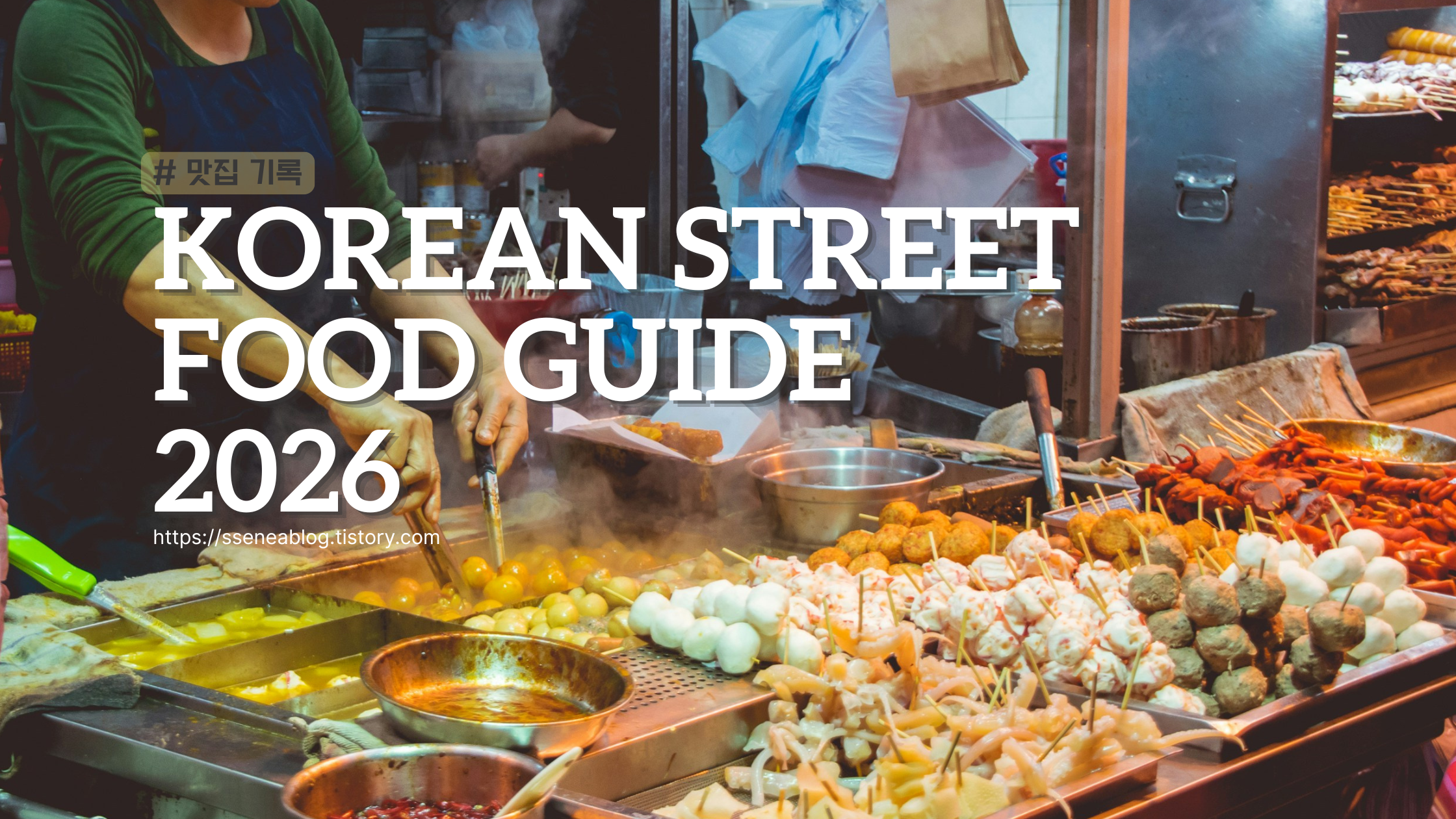
The Distinction That Matters: Tourist Street Food vs Local Street Food
The single most important thing to understand before you go is the distinction between tourist street food (Myeongdong, Insadong) and local street food (Gwangjang, Tongin, Namdaemun).
That's not to say tourist areas are bad. Myeongdong is accessible, lively, and has genuine variety. But you'll pay 20–30% more, and the experience skews toward performance rather than food. Gwangjang is where locals actually eat — communal tables, vendors who've been doing this for decades, and prices that make sense.
The honest approach: start at Gwangjang, use Myeongdong for late-night energy and variety, and treat the others as bonuses depending on what you're after.
8 Korean Street Foods Worth Knowing
1. Tteokbokki (떡볶이) — Spicy Rice Cakes
The most ubiquitous Korean street food, and genuinely one of the best. Chewy rice cakes in a spicy, sweet gochujang sauce with fish cakes and boiled eggs. Available from pojangmacha street tent stalls, market stalls, and dedicated tteokbokki restaurants throughout the city. A portion costs ₩4,000–6,000.
The base formula hasn't changed, but in 2026 you'll find rose, soy, and cream variations showing up next to the original. If you want the traditional version, Sindang-dong near Sindang Station is where it started — an entire neighborhood of tteokbokki restaurants, many operating since the 1970s.
Where to try it: Any market; Sindang-dong for the traditional format; Hongdae for newer variations
2. Bindaetteok (빈대떡) — Mung Bean Pancakes
Gwangjang Market's signature dish. A thick, crispy-edged pancake made from ground mung beans, pan-fried until golden. The texture is somewhere between a pancake and a fritter, and the flavor is deeply savory. It pairs with makgeolli (rice wine) in a combination that's been the same for decades.
Gwangjang Market is one of Seoul's oldest markets and is famous for authentic Korean street food. Dating back to 1905, it's the one locals actually eat at. After Netflix's Street Food: Asia (2019) featured it, it went global. The lines are longer now. The food is still worth it.
Where to try it: Gwangjang Market — this is the reason to go
3. Hotteok (호떡) — Sweet Filled Pancakes
A Korean street food favourite, typically enjoyed during the colder months. Sweet pancakes filled with a mixture of brown sugar, cinnamon, and crushed peanuts, pan-fried until crispy. In 2026, a savory version stuffed with japchae (glass noodles and vegetables) is running alongside the classic.
Best eaten immediately while the filling is still molten. Hold from the edges — the centre is very hot.
Where to try it: Namdaemun Market (Gate 2 area) for the classic version
4. Kimbap (김밥) — Korean Rice Rolls
Often described as Korean sushi, though the comparison undersells it. Steamed rice, pickled radish, carrots, spinach, egg, and various proteins rolled in seaweed and sliced into rounds. It's a staple, not a novelty — office workers eat it for lunch, students eat it after class. Expect to pay ₩2,000–4,000 per roll.
The mayo tuna and cheese varieties are the most popular. Gwangjang Market's knife-cut kimbap stalls (naked kimbap, no seaweed) have become famous through travel media coverage.
Where to try it: Gwangjang Market, or any kimbap restaurant throughout the city
5. Sotteok Sotteok (소떡소떡) — Sausage and Rice Cake Skewers
Alternating bites of sausage and rice cake on a stick. Simple, portable, and mathematically perfect. The skewer is brushed with a sweet-spicy sauce and coated in sesame seeds. A 2026 street food staple that appears at most market and convenience store hot food sections.
Where to try it: Any GS25 or CU convenience store hot food counter; market stalls throughout the city
6. Twigim (튀김) — Korean Fried Snacks
A category more than a single dish: fried sweet potato, fried squid, fried vegetables, fried fish cake, all battered and fried to order. Usually sold in combination with tteokbokki — the standard order is tteokbokki + twigim + kimbap, which functions as a complete meal for under ₩10,000.
Where to try it: Any tteokbokki stall, usually sold together
7. Hotbar (핫바) — Fish Cake on a Stick
Processed fish cake on a skewer, either boiled in broth or fried. The boiled version comes with a cup of the broth on the side — savory, warming, and free. The fried version is crispier and more portable. It's comfort food, not a delicacy, and that's the point.
Where to try it: Convenience stores (GS25, CU, 7-Eleven) have reliable hot bars year-round
8. Hangang Ramen (한강 라멘) — Instant Noodles at the River
In Korea, street food isn't a budget option — it's how people actually eat. The Hangang ramen experience is the best example of this: instant noodles cooked in a dedicated machine at a Han River park convenience store, eaten on the grass by the water. It costs about ₩1,500–2,000 and is one of the most specifically Seoul things you can do.
Where to try it: Any convenience store at Banpo, Yeouido, or Ttukseom Han River Parks
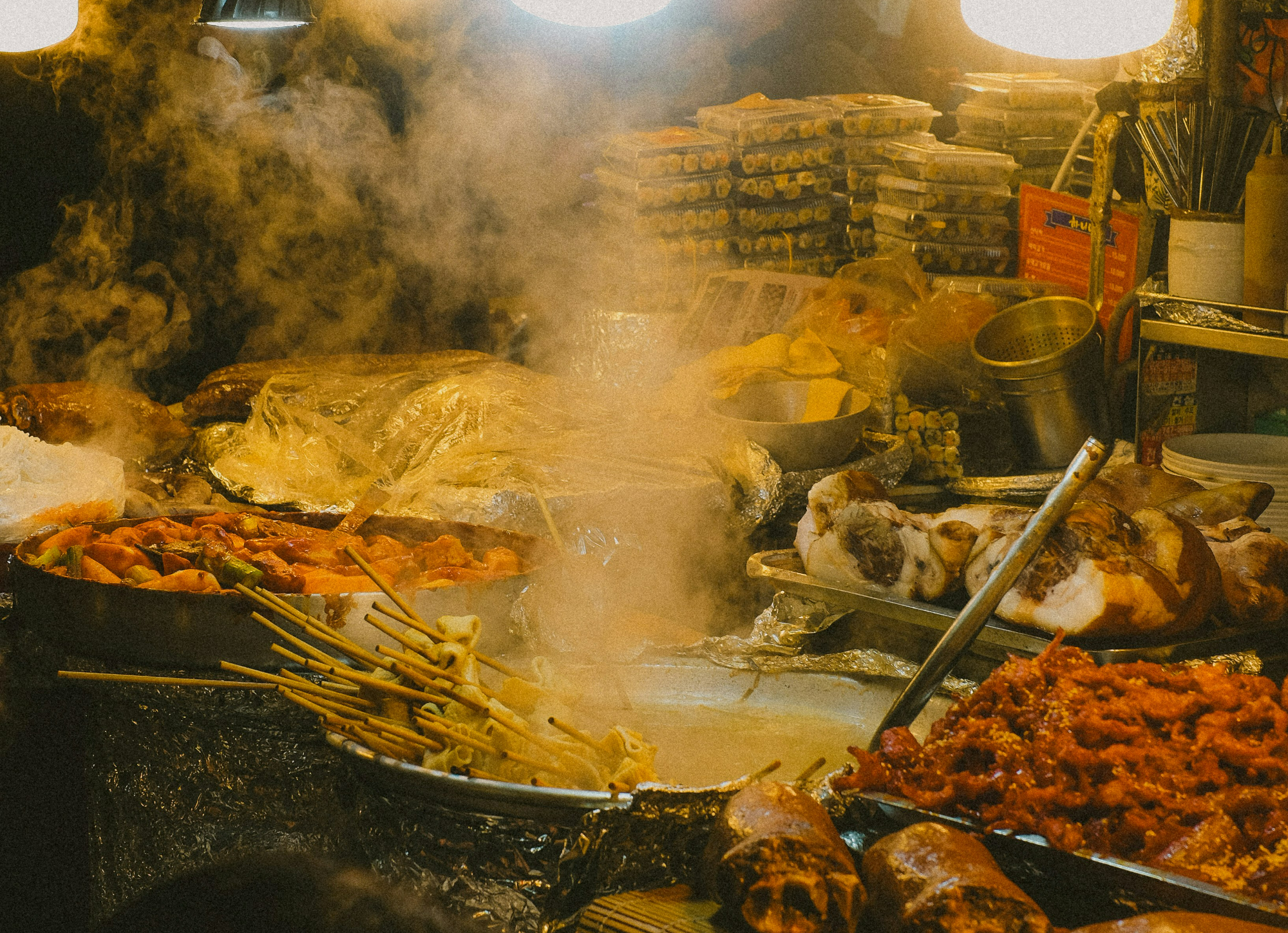
Where to Go: Seoul's Best Street Food Areas
Gwangjang Market (광장시장) — The Essential Stop
Gwangjang Market is one of the oldest traditional markets in Seoul and is famous for authentic Korean street food. Inside the market, vendors cook dishes directly in front of customers, creating a lively atmosphere filled with the smell of frying pancakes and boiling broth.
Getting there: Line 1, Jongno 5-ga Station (종로5가역), Exit 8 — direct access
Best time: Evenings; the atmosphere peaks after 6 PM
What to order: Bindaetteok, makgeolli, mayak kimbap, soondae (blood sausage)
Myeongdong (명동) — Accessible and High-Energy
Myeongdong's street food scene runs along the main pedestrian street and side alleys every evening from around 5 PM. The variety is excellent — skewers, pancakes, rolled egg omelettes, tornado potatoes, and Korean fried chicken all appear within 200 meters of each other.
Prices are slightly higher than local markets, but the variety is unmatched. Avoid laminated English menus with celebrity photos — typically 30% more expensive, no quality difference.
Getting there: Line 4, Myeongdong Station (명동역), Exit 5 or 6
Best time: 6–10 PM on weekday evenings (weekends get very crowded)
Hongdae (홍대) — Late Night and Trendy
The street food scene around Hongdae runs into the early morning hours and skews toward newer, more experimental items alongside the classics. If you want to try the 2026 fusion variations — rose tteokbokki, cream hotteok, various TikTok-adjacent inventions — this is where to find them.
Getting there: Line 2, Hongdae (Hongik Univ.) Station (홍대입구역), Exit 9
Best time: 8 PM onwards
Namdaemun Market (남대문시장) — Hotteok and Classics
The best hotteok in Seoul is found near Namdaemun Market Gate 2. The market itself sells everything, but the food alleys running through it offer some of the most reliable and affordable street food in the city. Less internationally famous than Gwangjang, which means shorter queues.
Getting there: Lines 1 & 4, City Hall Station (시청역), short walk
Practical Notes
Payment: Most street food vendors are cash-only. Bring small bills (₩1,000 and ₩5,000 notes). Markets occasionally have card readers at larger stalls, but don't count on it.
Ordering: At most street food stalls, point and hold up fingers for quantity. Prices are usually displayed. "Hana juseyo" (하나 주세요) means "one, please."
Eating while walking: Normal and expected. Most street food is designed for it.
Allergen information: Sesame, shellfish, and pork appear in many Korean street foods. If you have allergies, use Papago or Google Translate to communicate — most vendors will try to help.
Best seasons: Spring (April–May) and autumn (October–November) are the best times for outdoor market visits. Summer is hot and humid but the markets stay lively. Winter makes hotteok and ramen at the Han River significantly more appealing.
Quick Reference
| Food | Korean | Price | Where to Find |
| Tteokbokki | 떡볶이 | ₩4,000–6,000 | Everywhere; Sindang-dong for original |
| Bindaetteok | 빈대떡 | ₩5,000–8,000 | Gwangjang Market |
| Hotteok | 호떡 | ₩1,500–2,500 | Namdaemun, Insadong |
| Kimbap | 김밥 | ₩2,000–4,000 | Everywhere |
| Sotteok | 소떡소떡 | ₩2,000–3,000 | Convenience stores, markets |
| Hangang Ramen | 한강 라면 | ₩1,500–2,000 | Han River park convenience stores |
Start at Gwangjang, End at the River
The best approach to Seoul's street food scene in 2026 is also the simplest: show up at Gwangjang Market around 6 PM, sit at the communal tables, order bindaetteok and makgeolli, and let the atmosphere guide the rest of the evening. From there, the city has options in every direction. The Korean street food scene rewards wandering more than planning — but knowing the names, the prices, and which markets are worth the trip means you spend your time eating rather than deciding.
Hungry for more Seoul food guides? Check out our guides to budget sushi omakase, yakitori counters, and the best ramen in Seoul — the full picture of what the city's food scene has to offer.
🇰🇷 Read this in Korean: 서울 떡볶이 맛집 추천 2026 – 스타일별 성지 4곳 총정리
서울 떡볶이 맛집 추천 2026 – 스타일별 성지 4곳 총정리
서울 떡볶이 맛집 추천 2026 – 스타일별 성지 4곳 총정리안녕하세요. Ssenea 입니다. 🥰떡볶이는 대표적인 한국인의 소울푸드예요. 학교 앞 포장마차에서 처음 먹은 그 빨간 국물의 기억부터, 어
sseneablog.tistory.com
'어디 가볼까' 카테고리의 다른 글
| National Museum of Korea 2026 – Complete Visitor Guide for First-Timers (1) | 2026.08.05 |
|---|---|
| 전주 한옥마을 당일치기 코스 2026 – 먹거리부터 관광까지 완벽 가이드 (0) | 2026.08.04 |
| Best Night Views in Seoul 2026 – Where to Go After Dark (0) | 2026.08.03 |
| 서울 근교 드라이브 당일치기 BEST 4 – 차 있으면 꼭 가봐야 할 곳 (0) | 2026.08.03 |
| Gapyeong & Chuncheon Day Trip from Seoul 2026 – Nami Island, Rail Bike, and More (0) | 2026.08.03 |