National Museum of Korea 2026 – Complete Visitor Guide for First-Timers
Hi there, this is Ssenea. 😎
The National Museum of Korea drew 6.5 million visitors in 2025 — third in the world by attendance, behind only the Louvre and the Vatican. Foreign visitor numbers have increased 24-fold in five years. In June 2026 alone, a record 43,380 international visitors came through the doors.
If you're planning a trip to Seoul and haven't added this to your itinerary yet, this guide covers everything you need: how to get there, what to see, how long to spend, where to eat, and how to make the most of a building that is significantly larger than it looks from the outside.
Basic Information
| Item | Details |
| Address | 137 Seobinggo-ro, Yongsan-gu, Seoul |
| Hours | Tue–Sun 10:00 AM – 6:00 PM / Wed & Sat until 9:00 PM / Closed Monday |
| Summer hours (Jul 27–Aug 17) | 9:00 AM – 6:00 PM (extended for summer holiday crowds) |
| Admission | Free (permanent collection) |
| Closed | Mondays, New Year's Day, Lunar New Year, Chuseok |
| Website | museum.go.kr (English available) |
Admission: Free in 2026 — but this is changing
The permanent collection has been free since 2008. In March 2026, the government officially announced plans to introduce paid admission as part of the 2027 budget guidelines. A pilot system is being built in 2026, with a target launch of early 2027. The exact price has not been confirmed — figures of ₩5,000–10,000 for adults have been discussed in the media.
If you're visiting in 2026, entry is still free. If you're planning a 2027 visit, budget for an admission fee and check museum.go.kr for the latest.
How to Get There
By Subway — The Easiest Option
Take Line 4 or the Gyeongui-Jungang Line to Ichon Station (이촌역), Exit 2. The station is connected directly to the museum via an underground walkway — it's approximately a 5-minute walk from the exit to the museum entrance, entirely indoors.
This is by far the most convenient option. No navigation required, no outdoor walking in rain or heat. Follow the signs from the exit and you'll arrive at the main entrance.
From major Seoul locations:
- Myeongdong: Line 4 direct to Ichon (approx. 15 min)
- Hongdae: Transfer at Gongdeok to Line 4 (approx. 25 min)
- Dongdaemun: Line 4 direct to Ichon (approx. 20 min)
- Gangnam: Transfer to Line 4 at Express Bus Terminal (approx. 30 min)
By Taxi or Ride-Share
Tell the driver "국립중앙박물관" (Gungnipcheungang Bangmulgwan) or show the address on your phone. From central Seoul, expect ₩8,000–15,000 and 15–25 minutes depending on traffic.
What to See — The 5 Must-See Highlights
The museum has over 400,000 artifacts across six floors and eleven galleries. Don't try to see everything. These five stops give you the essential experience in 2–3 hours.
1. Gyeongcheonsa Temple Pagoda — First Thing You See
As soon as you enter the central hall, you'll be greeted by the Gyeongcheonsa Temple Pagoda. Standing 13.5 meters tall, this white marble masterpiece from the Goryeo Dynasty (1348) is perfect for photography, especially with the natural light pouring from the glass ceiling.
You can't miss it — it occupies the entire central atrium of the building. Take your time here before moving into the galleries.
2. Hall of Pensive Bodhisattvas — The Most Beautiful Room in the Museum
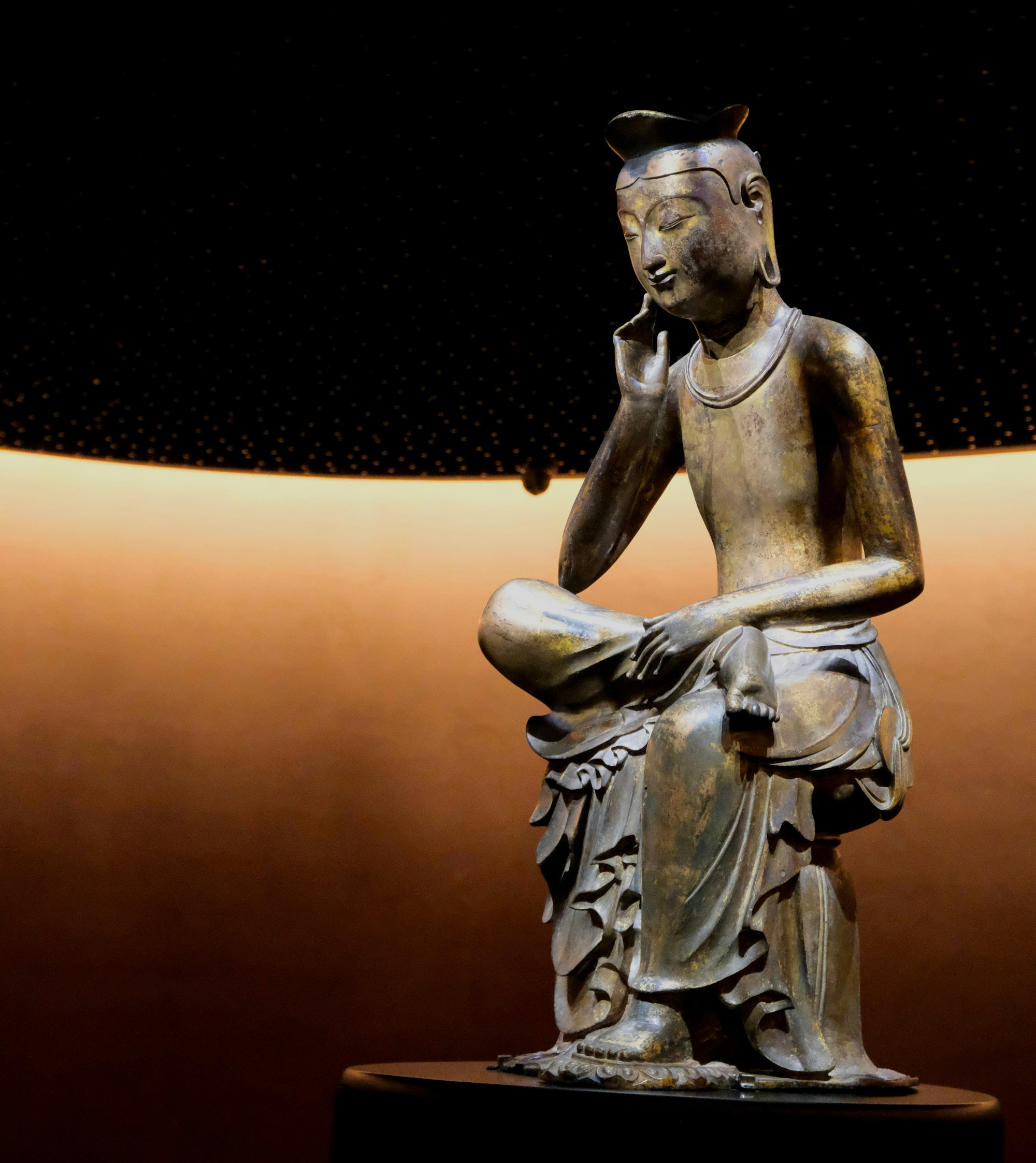
This is the heart of the museum. It houses two Pensive Bodhisattva statues (National Treasures). The room's minimalist, dark, and curved design is specifically engineered for a meditative experience. It's widely considered one of the most beautiful museum displays in the world.
The Pensive Bodhisattva (반가사유상) — a seated bronze figure with one leg crossed and a hand resting lightly against its cheek — is the most iconic single object in Korean art history. The display room is designed around these two figures specifically. Spend at least 15 minutes here.
Location: 2nd floor, Central Hall
3. Goryeo Celadon — The Reason Korea Is Famous for Ceramics
Korean celadon from the Goryeo Dynasty (918–1392) is considered one of the greatest achievements in world ceramics. The jade-green glaze — never fully replicated elsewhere — and the inlay technique of white and black designs beneath the surface reached their peak in the 12th century.
The National Museum holds the finest public celadon collection in the world. A 900-year-old vase that looks like it was made this morning is a specific kind of museum experience. The ceramics galleries are on the 3rd floor.
Location: 3rd floor, Ceramics Gallery
4. Immersive Digital Gallery 2 — Ancient Art, Giant Screens
Korea is a tech giant, and this gallery proves it. Huge LED screens (up to 60 meters wide) bring traditional Korean masterpieces like "Royal Procession with the People" to life. It's a 360-degree sensory journey that makes ancient art feel incredibly modern and cinematic.
This is a VR/immersive media experience that requires advance online reservation. Worth booking before your visit — the combination of traditional artwork and immersive technology is genuinely impressive and unlike anything in most museums.
Reservation: museum.go.kr → Visit → VR Tours
5. Silla Gold Crowns — The Kingdom of Gold
Witness the breathtaking brilliance of the "Kingdom of Gold." Adorned with shimmering gold spangles and comma-shaped jade beads, these crowns showcase the peak of 5th-century royal craftsmanship. As a highlight of the permanent exhibition, they provide a mesmerizing window into the luxury and artistic soul of the Silla Dynasty.
The Silla Dynasty (57 BCE–935 CE) produced some of the most technically accomplished goldwork in ancient world history. These crowns, excavated from burial mounds in Gyeongju, are exactly as extraordinary in person as in photographs.
Location: 1st floor, Ancient Korea Gallery
English-Language Guided Tours — Free, No Reservation Required
Museum Highlights Drop-in Guided Tours for foreign visitors are available in English, Chinese, and Japanese. Schedule: weekdays at 10:30 AM and 1:30 PM. Meeting point: in front of the Korean Empire Gallery on the 1st floor of the Permanent Exhibition Hall. No reservation required.
This is the single most useful thing a first-time visitor can do. Show up at 10:30 AM on a weekday, find the meeting point on the 1st floor, and join the tour. The guides explain context that the labels alone don't convey — the difference between knowing you're looking at a Goryeo celadon and understanding what made Goryeo celadon extraordinary.
Practical tip: Weekend tours may not be available at the same times — check museum.go.kr before your visit for the current schedule.
Recommended Visit Routes
2-Hour Highlight Route
Perfect for visitors with limited time who want to see the essential pieces.
- Arrive at main entrance → Central Hall pagoda (10 min)
- 1F Ancient Korea → Silla Gold Crowns (30 min)
- 2F Buddhist Sculpture → Pensive Bodhisattva room (30 min)
- 3F Ceramics → Goryeo Celadon (30 min)
- Outdoor garden → Mirror pond + Namsan view (10 min)
3-Hour Full Route
Add the Joseon Dynasty court art galleries and the Immersive Digital Gallery.
- Join the 10:30 AM English guided tour (60 min)
- Ceramics Gallery — explore independently after the tour (30 min)
- Immersive Digital Gallery 2 (pre-book online) (30 min)
- Joseon court art and painted screens (30 min)
- Outdoor garden and café break (30 min)
Practical Notes
Free lockers: Available in the Great Hall for bags and personal belongings. Use them — the museum is large and carrying a heavy bag through six floors is not ideal.
Wheelchair access: Full accessibility throughout, with ramps and spacious elevators on all floors. Wheelchairs available to rent free at the information desk. Strollers also available for families.
Children's Museum: Interactive hands-on exhibits, popular with families. Operates on a timed-entry reservation system — book in advance at museum.go.kr if visiting with children.
Photography: Permitted throughout the permanent galleries without flash. Photos are allowed of virtually all objects including the Pensive Bodhisattva. Professional equipment and tripods require advance permission.
WiFi: Free throughout the building.
Language: Most permanent gallery labels include English. The museum app (available on the museum website) provides English collection information and floor maps.
Food and Shopping
Food court: Located in the West Wing, 1st floor. 370 seats, serving Korean, Chinese, Western, and snack options. Reasonable prices, good for families.
Café: Ediya Coffee operates five café locations inside the museum under the concept "5 Resting Points" as of 2026. The outdoor café near the mirror pond is the most scenic option.
Museum shop: The museum's merchandise brand "MU:DS" has developed a following internationally. The Pensive Bodhisattva miniature has gone viral globally and is one of the most sought-after souvenirs in Seoul in 2026. The shop also carries celadon-inspired ceramics, art books, and Korean craft objects.
The Outdoor Garden — Don't Skip It
The outdoor grounds of the National Museum of Korea are a favourite spot for photographers and visitors alike. The museum is one of the best-kept secret locations for a panoramic view of N Seoul Tower and Namsan Mountain.
The mirror pond (거울못) reflects the ten-story pagoda on clear days. The Cheongjajeong Pavilion beside the pond is a good place to rest after the galleries. In the evening, when the building lights up with Namsan behind it, the view is one of the more quietly spectacular things in Seoul.
If the weather is good, factor 20–30 minutes into your visit for the garden.
Tips for Getting the Most Out of Your Visit
Go on a weekday morning. The museum receives over 60,000 visitors per month in 2026. Weekend afternoons are genuinely crowded. Tuesday or Wednesday at 10:30 AM — joining the English tour as it starts — is close to ideal.
Don't try to see everything. The building is six floors and the fatigue is real. Pick your priorities before you arrive and build the route around them. The official website has suggested itineraries by time and interest.
Pre-book the Immersive Digital Gallery. It requires a reservation and sells out, especially on weekends. Book online at museum.go.kr before your visit.
Wednesday and Saturday evenings are quieter. The museum stays open until 9:00 PM on those nights. After 6:00 PM, the daytime crowds have thinned and the building takes on a different atmosphere.
Getting There Is the Easiest Part
The National Museum of Korea is one of the best museums in the world, it's free, and the subway drops you at the front door. The Pensive Bodhisattva room alone is worth building a Seoul afternoon around. The celadon collection is unmatched anywhere. The outdoor garden with Namsan in the background on a clear evening costs nothing and takes 20 minutes.
Put it on the itinerary before you assume you don't have time.
Planning more Seoul sightseeing? Check out our guides to Bukchon Hanok Village, Seoul night views, and the best day trips from the city.
📖 Interested in the must-see pieces in detail? → What to See at the National Museum of Korea 2026
National Museum of Korea 2026 – What to See and How to Visit for Free
National Museum of Korea 2026 – What to See and How to Visit for FreeThe National Museum of Korea is one of the largest museums in Asia. It holds over 310,000 artifacts across six permanent exhibition sections, has drawn nearly 4 million visitors a year,
sseneablog.tistory.com
'어디 가볼까' 카테고리의 다른 글
| 강릉 당일치기 코스 2026 – KTX 타고 바다·커피거리·중앙시장 총정리 (1) | 2026.08.10 |
|---|---|
| 경주 당일치기 코스 2026 – KTX 타고 신라 유적 하루에 정복하기 (0) | 2026.08.05 |
| 전주 한옥마을 당일치기 코스 2026 – 먹거리부터 관광까지 완벽 가이드 (0) | 2026.08.04 |
| Korean Street Food Guide 2026 – What to Eat, Where to Go, and What to Skip (0) | 2026.08.04 |
| Best Night Views in Seoul 2026 – Where to Go After Dark (0) | 2026.08.03 |