Korea Travel Tips for First-Timers 2026 – Everything You Need to Know Before You Go
Hi there, this is Ssenea. 😎
South Korea is one of the most first-timer-friendly countries in Asia. The transport system is efficient and well-signed in English, the food is extraordinary at every price point, cities are extremely safe, and the combination of modern cities, ancient palaces, coastal scenery, and mountain hiking means there's rarely a day without something genuinely worth doing.
That said, a few things work differently in Korea than in most other countries, and knowing them before you arrive saves real time and frustration. This guide covers the practical essentials — entry requirements, getting from the airport, getting around, money, connectivity, apps, etiquette, and what things actually cost — for a first visit in 2026.
Entry Requirements — Visa, K-ETA, and e-Arrival Card
Do You Need a Visa?
Citizens of most Western countries — including the US, UK, Australia, Canada, and most of Europe — can enter South Korea visa-free for up to 90 days for tourism. Check the Korean Embassy website for your specific country's status before booking.
K-ETA
South Korea uses a K-ETA (Korea Electronic Travel Authorization) system for some nationalities. Many countries are currently exempt, but requirements change frequently. Check k-eta.go.kr before your trip. The fee is ₩10,000 (around $7 USD) and it's valid for two years if required.
e-Arrival Card — New from 2025
From February 24, 2025, South Korea introduced an electronic arrival declaration system. All foreign visitors must complete the e-Arrival Card online within 3 days before arrival at e-arrivalcard.go.kr. The process is free of charge and takes about five minutes. Completing it in advance speeds up immigration noticeably.
Customs
You can bring in up to $10,000 USD (or equivalent) without declaration. Tobacco is limited to 200 cigarettes and alcohol to 2 bottles under 2 litres total.
Getting from Incheon Airport to Seoul
Incheon International Airport (ICN) is the main gateway into Korea, located about 50km west of central Seoul. It is large, well-organised, and has very good English signage.
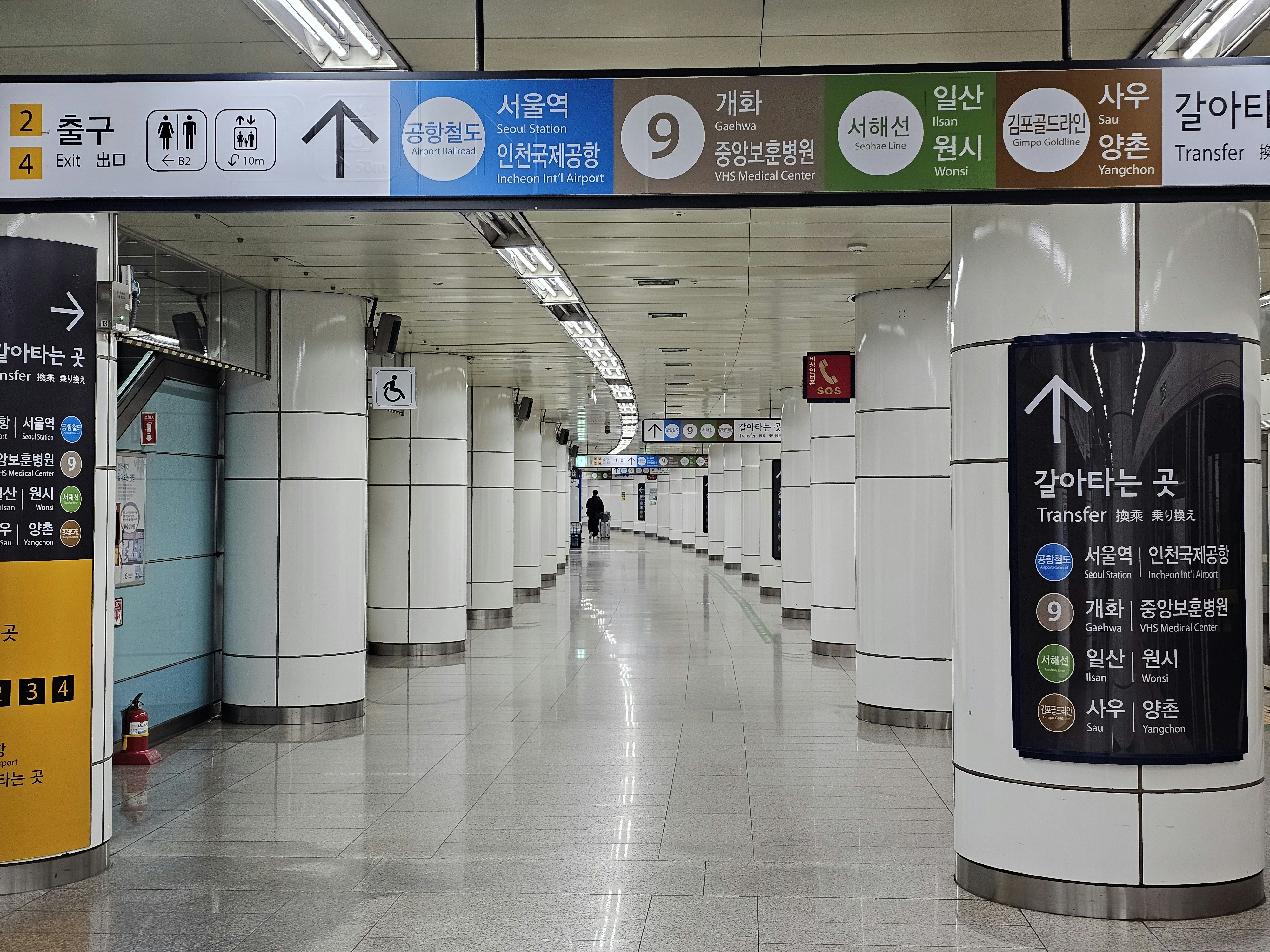
AREX (Airport Railroad Express): The most straightforward option. The All-Stop train takes approximately 1 hour to Seoul Station and costs around ₩4,150. The Direct Train takes 43 minutes to Seoul Station and costs ₩11,000. Trains run from early morning until after midnight.
Limousine Bus: Buses run directly from the airport to major hotel districts and neighbourhoods across Seoul. Costs ₩15,000–18,000 depending on route. Takes 60–90 minutes depending on traffic.
Taxi: Available from designated ranks outside arrivals. Standard taxi to central Seoul costs approximately ₩60,000–80,000 and takes 60–90 minutes. Kakao T app is the easiest way to book. Deluxe black taxis are more expensive but guaranteed English-capable.
First thing to do at the airport: Activate your SIM or eSIM, top up a T-money card, and get some Korean won cash. In that order.
Getting Around Korea
T-money Card — The Essential Transit Card
A T-money card is a rechargeable prepaid card used on subways, buses, and taxis across Korea. It's the single most useful item for getting around.
Pick one up at any convenience store — CU, GS25, or 7-Eleven — or at the airport. The card itself costs around ₩3,000–4,000 and you load credit onto it separately. Using T-money is cheaper than buying individual tickets and gives a small transfer discount when switching between subway and bus within a set time window.
One important note: topping up T-money often requires Korean won cash, not a foreign credit card, at many recharge machines and convenience store registers. Keep some cash available for this specifically.
Seoul Subway
Seoul's subway system has 9 lines and covers virtually every area a visitor would want to reach. A single journey costs ₩1,500–1,800 with T-money. The system runs from around 5:30 AM until after midnight. English signs and announcements are standard throughout.
Naver Map (available in English) gives more reliable transit directions in Seoul than Google Maps, which doesn't always have real-time Korean transit data.
KTX — Travelling Between Cities
The KTX bullet train connects Seoul with Busan (2 hours 30 minutes), Gyeongju, Daegu, and other major cities. Book through Korail's website (letskorail.com) or the Korail app. Advance booking is strongly recommended on weekends and public holidays.
The SRT train from Suseo Station in southern Seoul serves some routes slightly faster and at lower cost — useful if you're based south of the Han River.
Taxis
Taxis are metered, affordable by international standards, and available throughout cities. The KakaoTaxi app is the easiest way to book — it shows estimated fare before you confirm, accepts card payment, and lets you share your route for safety. Most drivers don't speak English, so having your destination typed in Korean (or pasted from Naver Map) saves confusion.
Money — Cards, Cash, and the No-Tip Rule
Currency
The Korean Won (₩) is the currency. As of 2026, approximately ₩1,000 = $0.70 USD / £0.55 GBP / €0.65 EUR. Notes come in ₩1,000, ₩5,000, ₩10,000, and ₩50,000 denominations.
Cards vs Cash
Korea is one of the most cashless societies in the world. Visa and Mastercard are accepted almost everywhere — restaurants, cafes, convenience stores, and most markets. AMEX works at larger stores but not always at small independent shops.
That said, cash is still useful for:
- Topping up T-money cards
- Traditional markets (Gwangjang, Namdaemun)
- Some older or smaller local restaurants
- Coin lockers and some vending machines
Use a card with no foreign transaction fees. Withdraw cash from ATMs inside GS25 or 7-Eleven convenience stores, which reliably accept international cards. Airport ATMs work but may charge higher fees.
Where to Exchange Currency
Avoid exchanging money at the airport — rates are significantly worse than in the city. The best exchange rates in Seoul are at the independent currency exchange shops clustered around Myeongdong and Hongdae. Many accept major foreign currencies at competitive rates with no commission.
Tipping
Tipping is not practiced in Korea. The price on the menu or bill is the total price. Leaving cash on the table after a restaurant meal is not expected and can occasionally cause confusion. This applies to hotels, taxis, and services as well.
Staying Connected — SIM Cards and WiFi
Airport SIM and eSIM
The easiest option for most visitors is buying a prepaid SIM card at Incheon Airport immediately after clearing customs. Major providers (KT, SKT, LG U+) have booths in both arrival terminals. Prices typically start around ₩15,000–30,000 for a 7–10 day data-only SIM.
eSIM is increasingly available and convenient — you can activate it before you land. Download your provider's app or use a global eSIM service and have data the moment you step off the plane.
Pocket WiFi
Pocket WiFi devices (portable routers) can be rented from airport counters or pre-ordered for airport pickup. They allow multiple devices to share one connection, which is useful for groups. Costs around ₩8,000–12,000 per day.
WiFi Coverage
Korea has excellent public WiFi coverage in subways, airports, major cafes, and public spaces. In practice, most visitors find the public WiFi reliable enough for maps and messaging between SIM top-ups, but not reliable for streaming or work.
Essential Apps
Download these before you arrive — some require a non-Korean App Store account to download inside Korea.
| App | What It Does |
| Naver Map | Best navigation for Korea, includes real-time transit |
| KakaoTaxi | Taxi booking, fare estimate, route sharing |
| Papago | Korean↔English translation, including camera translation for menus |
| KakaoTalk | Korea's universal messaging app — many restaurants and guesthouses use it |
| Korail / SRT | KTX and intercity train booking |
| Coupang Eats / Baemin | Food delivery (limited English UI but manageable) |
Naver Map is genuinely more useful than Google Maps for Korea. Google Maps has incomplete transit data and doesn't show real-time bus information accurately in many areas.
Cultural Etiquette — What to Know
You won't cause serious offence by accident as a tourist — Koreans are generally accustomed to visitors who don't know local customs. But knowing a few basics makes interactions smoother and earns visible appreciation.
Remove shoes indoors. When entering a Korean home, traditional restaurant with floor seating, or some temples, shoes come off at the entrance. Look for a shoe rack as your cue. Slip-on shoes make this much easier than laces.
Two hands. Give and receive things — especially money, drinks, and business cards — with both hands, or with one hand supported at the elbow by the other. A single hand, especially for money, reads as casual to the point of rudeness in formal contexts.
Pour for others, not yourself. At meals with drinks, fill others' glasses and let them fill yours. This applies to soju, beer, and tea. Pouring your own is technically impolite, though in casual tourist settings no one will say anything.
Chopstick rules. Don't stick chopsticks upright in a bowl of rice — this resembles incense at a funeral. Don't pass food chopstick-to-chopstick for the same reason. Rest chopsticks on the provided rest or lay them flat on the table.
Quiet on public transport. Phone calls on the subway are considered inconsiderate. Most Koreans use headphones and keep voice volume low. This is widely observed and easy to follow.
Before eating: Koreans say "잘 먹겠습니다" (jal meokgesseumnida — I will eat well) before starting a meal. After finishing: "잘 먹었습니다" (jal meogeosseumnida — I ate well). Using these isn't expected of tourists but produces obvious delight when it happens.
Age and hierarchy. Korean culture has a strong sense of hierarchy based on age and social position. In practical tourist terms, this mainly means: wait for elders to begin eating before you start, and address service staff politely.
Safety and Health
Safety: Korea is extremely safe by international standards. Violent crime against tourists is rare. Solo travellers and female travellers routinely feel comfortable even late at night in major cities. Normal city awareness applies — watch for delivery scooters on pavements, which can be aggressive.
Tap water: Technically safe to drink, but most Koreans drink filtered or bottled water. Bottled water costs ₩800–1,000 at any convenience store.
24-hour emergency line: 1330 (Korea Travel Hotline) — English-speaking operators available 24 hours. Use for travel emergencies, questions, or translation help.
Medical: Pharmacies (약국, yakguk) are easy to find in any neighbourhood. Many stock standard international medications. Emergency rooms at major hospitals have English-speaking staff in Seoul and other major cities.
What Things Cost — Budget Reference
Korea sits between Southeast Asia and Japan in cost. Food and city transport are inexpensive; accommodation and long-distance travel are the main costs.
| Item | Cost |
| Subway or bus single journey | ₩1,500–1,800 |
| Convenience store meal | ₩3,000–6,000 |
| Restaurant lunch (Korean) | ₩8,000–15,000 |
| Coffee at a cafe | ₩5,000–7,000 |
| KTX Seoul → Busan (one way) | ~₩59,800 |
| Budget guesthouse / hostel | ₩25,000–50,000 per night |
| Mid-range hotel | ₩80,000–150,000 per night |
| Daily budget (mid-range) | ₩130,000–230,000 per person |
Useful Korean Phrases
You don't need to learn Korean to travel in Korea — English signage is good in major cities and tourist areas. But a handful of phrases gets you further than you might expect.
| Phrase | Korean | Pronunciation |
| Hello | 안녕하세요 | Annyeonghaseyo |
| Thank you | 감사합니다 | Gamsahamnida |
| Excuse me | 실례합니다 | Sillyehamnida |
| How much? | 얼마예요? | Eolmayeyo? |
| Where is...? | ...어디예요? | ...eodiyeyo? |
| One more, please | 하나 더 주세요 | Hana deo juseyo |
| It's delicious | 맛있어요 | Massisseoyo |
| I'll eat well | 잘 먹겠습니다 | Jal meokgesseumnida |
Papago's camera translation is the most practical tool for menus and signs when phrases don't cover it.
First-Timer Mistakes to Avoid
Not completing the e-Arrival Card before landing. You can do it at the airport, but it adds unnecessary time at a busy immigration queue.
Exchanging money at the airport. Rates are noticeably worse than city exchange shops. Get enough for transport and your first day, then exchange the rest in Myeongdong or Hongdae.
Relying only on Google Maps. Download Naver Map. Google Maps transit data is frequently incomplete or delayed in Korea.
Not having any cash. Korea is very cashless, but T-money top-ups and some traditional market stalls still need it. Keep ₩30,000–50,000 in small bills.
Over-scheduling Seoul. Seoul is large and travel between areas takes real time. Grouping nearby places into each day — rather than criss-crossing the city — produces a much better experience.
Missing the e-Arrival Card entirely. It's free, takes five minutes, and should be done 1–3 days before arrival at e-arrivalcard.go.kr.
Korea Is Worth the Preparation
Most of the practical complexity of visiting Korea front-loads into the first two hours: clear immigration (smoother with the e-Arrival Card done), pick up a SIM, top up a T-money card, get some won. After that, the country is remarkably easy to navigate — the transport works, the food is everywhere and excellent, the people are helpful, and there's more to see than most itineraries allow for.
The 1330 Korea Travel Hotline is available 24 hours in English if you need it. Beyond that, a charged phone with Naver Map and Papago covers most situations.
Planning where to go? Check out our guides to Seoul, Busan, Incheon, and Gyeongju for city-specific recommendations.
🇰🇷 Read this in Korean: 한국 여행 처음이라면 꼭 읽어야 할 것들 2026
한국 여행 처음이라면 꼭 읽어야 할 것들 2026 – 입국부터 교통·에티켓·예산까지 완벽 가이드
한국 여행 처음이라면 꼭 읽어야 할 것들 2026 – 입국부터 교통·에티켓·예산까지 완벽 가이드안녕하세요. Ssenea 입니다. 🥰한국을 처음 방문하는 외국인 친구나 해외 교포 가족이 "한국 여행 준
sseneablog.tistory.com
'어디 가볼까' 카테고리의 다른 글
| Nami Island Day Trip from Seoul 2026 – Complete Guide with Chuncheon, Rail Bike, and Dakgalbi (0) | 2026.08.26 |
|---|---|
| 부산 여행 가이드 2026 – 볼거리·먹거리·숙소까지 첫 방문자를 위한 완벽 총정리 (0) | 2026.08.25 |
| 한국 여행 처음이라면 꼭 읽어야 할 것들 2026 – 입국부터 교통·에티켓·예산까지 완벽 가이드 (0) | 2026.08.25 |
| 파주 당일치기 여행 2026 – 헤이리마을·임진각·프로방스 완벽 코스 총정리 (0) | 2026.08.25 |
| Busan Travel Guide 2026 – Best Things to Do, Eat, and See in Korea's Second City (0) | 2026.08.25 |